
Best AI for game development, six tools compared

On this page
Which tool should you pick?
Start with whatever your current plan already covers, and judge it on one small game. You’re really choosing between two kinds of tool, agents and editors that work in your project folder, and prompt-to-app builders that live in the browser.
-
Claude Code if you pay for a Claude plan, since paid plans include it. Creators list it more often than any other tool, and the Claude Code guide gets you started.
-
Codex if you pay for ChatGPT, since every ChatGPT plan includes it. Creators list it on the games that placed #2 and #3 in the jam, and there’s a Codex guide too.
-
Cursor if you want an editor where you read and edit the code beside an agent. The Hobby plan is free, creators list it on the games that placed #4 and #5 in the jam, and the Cursor guide walks you through it.
-
Lovable or Bolt to stay in the browser and publish from the tool. Both have free tiers, but they appear on only 9 and 6 listed games, so there’s not a lot to compare them on.
-
Antigravity for a free start with Gemini models. It’s free for individual developers, it appears on 20 listed games, and make games with Gemini covers it.
You don’t even have to pick just one. If you like Cursor’s editor, Anthropic lists a Claude Code extension for it, and the Codex README lists an extension for VS Code, Cursor and Windsurf.
Use a different AI for each job in a game
A coding tool writes the game, but the other jobs each have a better place to start. Each row links to the guide that covers it, sources included.
| Job | Where to start | Guide |
|---|---|---|
| Code and the game loop | Claude Code, Codex or Cursor, compared below | This page |
| 2D art and sprites | Art your coding agent draws in code; an image model only for pictures you keep as files | Game assets with AI |
| Sprite animation | One approved character reference, then frames aligned on a shared canvas | AI sprite animation |
| 3D models | An image-to-3D tool such as Meshy, Tripo, Rodin or TRELLIS, exported as a GLB | Image to 3D |
| 3D animation | An auto-rig, then a clip library, text-to-motion or motion capture from video | AI 3D animation, Kimodo |
| Sound effects and music | ZzFX or jsfxr tuned in code; ElevenLabs, Suno or Stable Audio for files | AI sound and music |
| NPC dialogue | A small server-side proxy that holds the key and caps spending | AI NPC dialogue |
| Testing | A Playwright test that plays a round, run by your agent after every change | Playtesting with AI |
| Game feel | Techniques asked for by name, one per prompt: coyote time, hit stop, screen shake | Game feel with AI |
| Editors and tools | MCP servers: a browser server first, then Blender, Godot, Unity or Unreal | MCP servers |
How the six tools compare
If you leave out chat apps, these are the six tools named most often on our 588 listed games, and they’re not all the same kind of thing. Claude Code and Codex are agents, Cursor is an editor, Lovable and Bolt are browser builders, and Antigravity is an agent-first IDE.
The chat apps are named too, with the Claude app on 28 games and the Gemini app on 10.
| Tool | Type | Models | Price, as of September 2026 | Best for |
|---|---|---|---|---|
| Claude Code | Agent: terminal, IDE extensions, desktop app, web | Claude Fable 5.1, Opus 5.5, Sonnet 5.5, Haiku 4.5 | Paid Claude plans: Pro $20 a month, Max from $100. API rates per token with a Console account | Long-running agent work in your project folder |
| Cursor | Editor with agents: desktop editor, CLI, cloud agents | Its own models plus models from Anthropic, OpenAI, Google and others | Hobby free. Pro $20, Pro+ $60, Ultra $200 a month | Reading and editing code beside an agent |
| Codex | Agent: CLI, IDE extension, desktop app, cloud | GPT-6 Astra, GPT-6.1 Sol and GPT-6 Luna | Included in ChatGPT plans: Plus $20 a month, Pro from $100. Free and Go are lighter | ChatGPT subscribers, and cloud tasks that can end in pull requests |
| Lovable | Prompt-to-app builder in the browser | Not named in its docs | Free with 5 daily credits. Pro from $25 a month | Web apps from chat, with GitHub sync |
| Antigravity | Agentic platform: IDE, agent manager, CLI, SDK | Gemini 3.8 Flash and 3.1 Pro, Claude Sonnet and Opus 4.6, gpt-oss-120b | Free for individual developers | A free start with parallel agents |
| Bolt | Prompt-to-app builder in the browser | Routes each task to a model | Free. Pro $25 a month | Prompt-to-app with hosting on every plan |
The table draws on each maker’s own pages.
- For Claude Code, Anthropic’s product page, documentation and model overview.
- For Cursor, its plans and pricing, documentation and models.
- For Codex, OpenAI’s pricing and models pages and the README.
- For Lovable, its subscription plans and overview.
- For Antigravity, Google’s site and pricing.
- For Bolt, its pricing and homepage.
In case you landed here looking for something else, Codex here is OpenAI’s coding agent and Cursor is the AI code editor from Anysphere, not the board games or aim trainers with those names. This comparison covers tools that write game code, so for art, audio, animation and NPCs, the job table above is the better place to look.
All three agents write Unity and Godot code
Claude Code, Codex and Cursor all write C# and GDScript, and MCP servers let them drive the editors too. Unity has actually leaned into this. Its own AI tools, for Unity 6 or later, include a gateway that brings Claude, Codex or Gemini into the editor (Unity). It also publishes an official Claude Code plugin with 29 skills (Unity blog), and the README says that plugin works in Codex too, so it isn’t only for Claude (repo).
Unity’s CLI connects Claude Code or Cursor to a running editor through unity mcp configure (Unity CLI). For Godot, community servers such as godot-mcp launch the project and read its debug output, and MCP servers for game development covers setup for both.
We can’t separate the tools on these engines from our own data, though, with 6 Unity and 16 Godot games among the 588 we list.
Which tools creators name, and where they placed
Creators name Claude Code most often, but the jam’s top five games are split pretty evenly between Claude Code, Codex and Cursor.
These counts are as of November 14, 2026. Of the 588 games we list, 414 are Vibe Jam 2026 entries.
That jam required at least 90% of the code to be written by AI. Creators name the tools themselves, mostly in the jam submission form, and we don’t verify them (how we count).
| Tool | Listed games | Top-ten Vibe Jam 2026 games we list |
|---|---|---|
| Claude Code | 224 (38%) | 3 |
| Cursor | 106 (18%) | 4 |
| Codex | 101 (17%) | 3 |
| Antigravity | 20 | 0 |
| Lovable | 9 | 0 |
| Bolt | 6 | 0 |
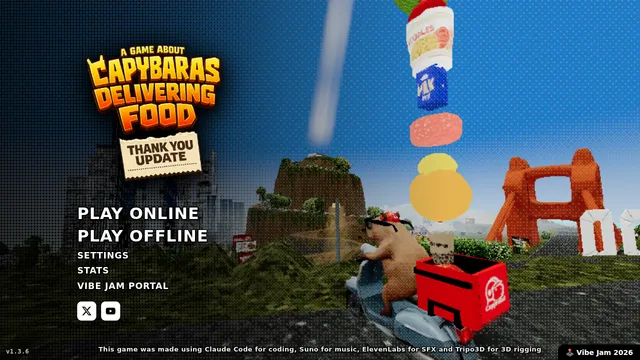
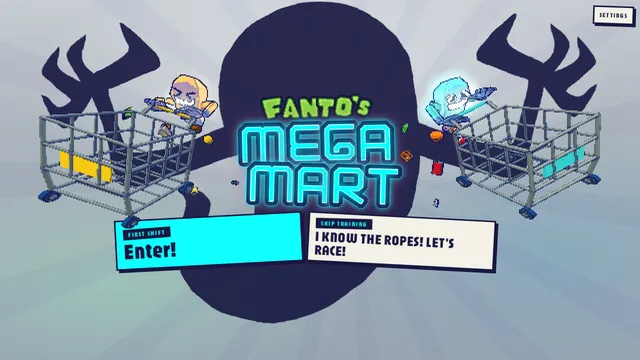
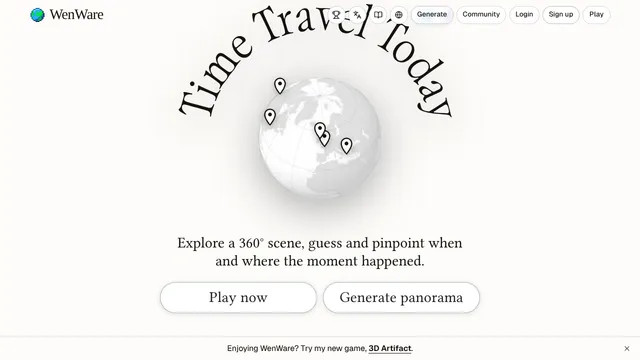
The capybara courier that won, A Game About Capybaras Delivering Food, lists Claude Code. The haunted grocery race Fanto’s Mega-Mart (#2) and the history guessing game WenWare (#3) both list Codex.
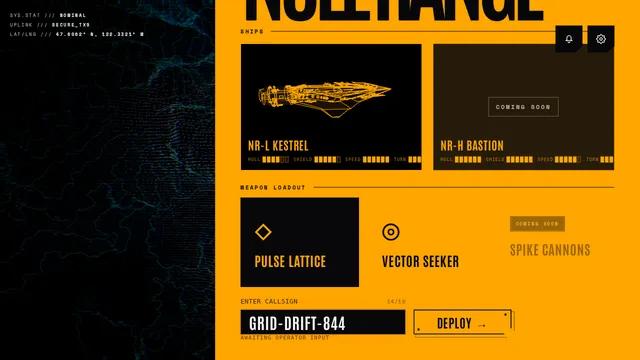
Cursor shows up right behind them, on the space dogfighter Null Range (#4) and the ASCII horror story HALDANE-4 (#5).
Further down, Sunset City - The Dark Tower (#8) lists Claude Code again and Kanso (#9) lists Codex.
The jam’s results post names the top three, and we list 10 of the top ten.
The next table shows what the games made with each of the three leading tools look like, as shares of that tool’s games.
| Tool | Use Three.js | Playable on mobile | Online multiplayer | Top genre |
|---|---|---|---|---|
| Claude Code (224 games) | 58% | 58% | 39% | Action |
| Cursor (106 games) | 72% | 63% | 47% | Action |
| Codex (101 games) | 66% | 52% | 42% | Action |
| All 588 games | 55% | 50% | 34% | Action |
Action is the most common genre for all three tools, so genre doesn’t really separate them. Most of each tool’s games use Three.js and list mobile, which is true of the catalog as a whole too.
These counts tell you what the creators of listed games used, not which tool is better. It also helps to know that Cursor sponsored the jam, which its official page calls Cursor Vibe Jam 2026, and Bolt.new sponsored it too. The press page recommends both tools, which may raise their counts.
The shares in the Listed games column use all 588 games as the base.
Of those, 53 name more than one tool, 67 name none and 61 name a model version.
Tools or models?
We compare tools rather than models because only 61 of the 588 listings name a model version. Claude Code runs Claude models from Anthropic and Codex runs GPT models from OpenAI, while Cursor lets you choose between several makers.
If you’re curious about the makers behind the tools, there’s games made with Claude and OpenAI games. The jam rules allow any engine and recommend Three.js (jam rules), and 322 of the 588 games use it, so the Three.js hub is a pretty good place to browse.
How we put this together
We read each maker’s own documentation and pricing pages in September 2026, so every tool fact is as of that month. The tool counts cover the 588 games in our catalog as of November 14, 2026, with the tools their creators named.
We didn’t run any benchmarks, and this page doesn’t rank tools by quality. Prices and plans do change, so check the linked pages before you pay.
Go deeper on one tool
Claude Code game development and Codex game development give you a workflow for each agent, and best AI game makers looks at the game-maker side of the same question.
Claude Code vs Codex for game development puts the two agents side by side. Cursor game development, make games with Gemini and make games with ChatGPT take one tool at a time. If you’re just starting, how to make a game with AI and vibe coding a game cover the basics, whatever tool you use.
For games to look at, there are hubs for Claude Code games, Codex games and Cursor games, plus the Vibe Jam 2026 archive and the top rated games.
Games to look at
 , Phone friendly , Online multiplayer
A Game About Capybaras Delivering Food
Drive capybaras around a cozy open world delivering food without toppling the fruit stack.
 ClaudeSimulation 2 votes
 , Online multiplayer
Fanto's Mega-Mart
Race through a haunted grocery store at rocket speed, grabbing items as you go.
 , Phone friendly , Online multiplayer
WenWare
Guess the place and year of a 360-degree historical scene.
 , Phone friendly , Online multiplayer
Null Range
Fly a first-person spacecraft and dogfight other pilots online
 , Phone friendly
HALDANE-4
Descend alone beneath the Antarctic ice and uncover what waits below in ASCII.


Questions
What is the best AI for coding video games?
No single tool wins in our data. Of the 10 top-ten Vibe Jam 2026 games we list, Codex has 3, Claude Code 3 and Cursor 4, and across all 588 listed games creators name Claude Code on 224, Cursor on 106 and Codex on 101. So pick by workflow and by the plan you already pay for.
Claude Code or Codex for game development?
Both can produce a top jam game, since the #1 entry lists Claude Code and #2 and #3 list Codex. Claude Code is named on more games, 224 versus 101, but that reflects how many people use it, not how good it is. Claude Code comes with Claude plans and Codex with ChatGPT plans.
What is the best AI for Unity game development?
Claude Code, Codex and Cursor all write C# for Unity, and Unity supports them directly. Unity's own AI tools for Unity 6 include a gateway that brings Claude, Codex or Gemini into the editor, and Unity publishes a Claude Code plugin with 29 skills that also works in Codex. Its CLI connects Claude Code or Cursor to a running editor, and the community MCP for Unity server works with any MCP client.
What is the best AI for making HTML games?
For browser games, creators in our catalog most often name Claude Code, Cursor and Codex, and 322 of our 588 listed games use Three.js. The jam rules allow any engine and recommend Three.js.
Is there a free AI for making games?
Yes. As of September 2026, Cursor's Hobby plan, Antigravity for individual developers and the free tiers of Lovable and Bolt all give you a free start. Claude Code needs a paid Claude plan or a Console account, while Codex has lighter Free and Go plans.