
Can you sell games made with AI? Steam, itch.io

Yes, you can sell a game made with AI on Steam and itch.io. Before you do, check what the store asks you to disclose and what it charges, who owns the output under your tool’s terms, and how much of the game copyright protects. We checked every rule below in September 2026, and each names its source and date.
This page is information, not legal advice. The copyright material is US only, and other countries have their own rules. We did not check app stores, the Epic Games Store or other markets; for free web portals, see where to publish a browser game.
The rules at a glance
None of the store rules we checked bans a game for being made with AI. They ask for disclosure and for clear rights to what you ship.
| Where | What it asks | Source and date |
|---|---|---|
| Steam | Disclose AI-generated content that ships with the game. Describe guardrails for content generated while the game runs. | Steamworks Content Survey, checked September 2026 |
| itch.io | Say whether a project contains generative AI and which kinds, code included. | itch.io announcement, November 20, 2024 |
| US Copyright Office | Copyright covers what a human authored. Prompts alone are not enough with today’s tools. | Part 2 report, January 29, 2025 |
| Your AI tool | Output rights usually pass to you, but commercial-use wording differs by tool and plan. | Each tool’s terms, September 2026 |
Steam’s AI disclosure
You disclose AI-generated content in two forms. Steam’s Content Survey separates pre-generated content, made with AI during development and shipped with the game, from live-generated content, created by AI while the game runs. For live-generated content you also describe the guardrails that keep the AI from producing illegal content (Content Survey).
The survey names artwork, sound, narrative and localization as examples, and says efficiency gains from AI tools are not its focus. It does not name code.
Game Developer reported on January 16, 2026 that Valve had updated the form’s AI wording (Game Developer). Developers do not need to disclose AI-powered tools such as code helper software used for workflow, it said.
You also promise that the game contains no illegal or infringing content, and Valve reviews AI-generated output the same way it reviews other content. Confirm the current wording in the Steamworks form for your game.
itch.io’s AI tags
You answer the AI Disclosure section on your project’s edit page. As of September 2026, it asks whether the project contains generative AI and which kinds: graphics, sound, text and dialog, or code.
Answer yes and the page gets an AI Generated tag plus sub-tags such as AI Generated Code. Answer no and it gets No AI (announcement).
The field is required for asset creators. For games, itch.io’s quality guidelines ask you to tag accurately, and they say disclosure is strictly enforced for asset pages (guidelines). Projects that disclose generative AI appear on the AI Assisted browse page. Traditional game AI, such as NPC pathfinding or procedural level generation, needs no tag.
itch.io’s terms also have you state that you own or have the rights to what you publish (terms).
The two stores draw the line differently. Steam’s public documentation names shipped content such as art and sound, while itch.io’s form lists code as a kind of generative AI. If AI wrote your code, itch.io gives you a way to say so.
What Steam and itch.io charge
Steam charges a $100 Steam Direct fee for each game and pays it back once the game has made $1,000 in adjusted gross revenue (Steam Direct fee). Valve keeps 30 percent of revenue, dropping to 25 percent on revenue between $10 million and $50 million and to 20 percent beyond that (Steamworks announcement).
itch.io lets you set its share anywhere from nothing to the whole sale, and the default is 10 percent. Payment fees come on top, about $0.30 plus 2.9% per payment through PayPal or Stripe, so 30 cents of a $1 sale goes to the processor. Sellers outside the US also face US tax withholding, 30 percent by default and less where a tax treaty applies (itch.io payments).
What US copyright protects
Copyright protects what a human authored. The U.S. Copyright Office published Part 2 of its AI report, on copyrightability, on January 29, 2025. It concludes that AI output can be protected only where a human author has determined sufficient expressive elements (Office news).
With generally available tools today, prompts alone do not give a user enough control to be the author, the Office found. Human-authored material that is perceptible in an AI output can be protected, and so can a human’s creative selection, arrangement or modification of it.
Our reading, as a rule of thumb for a game: what you wrote, drew, edited, arranged or designed has the strongest claim, and what an AI produced from short prompts has the weakest.
If you register a work in the US, the Office’s guidance of March 16, 2023 puts a duty on applicants to disclose AI-generated content (Office news). Its AI page lists the guidance and the reports.
Who owns the output: six tools’ terms
Most of the terms we read give you the output, and the caveats differ by tool and plan.
| Tool | What the terms say | Source and date |
|---|---|---|
| Claude Code and Claude | Anthropic assigns its rights in outputs to you (Consumer Terms). The customer owns its outputs (Commercial Terms). | Consumer Terms, October 8, 2025; Commercial Terms, June 17, 2025 |
| Codex and ChatGPT | As between you and OpenAI, you own the output, as far as the law allows. | OpenAI Terms of Use, checked September 2026 |
| Cursor | Anysphere assigns its rights in generated suggestions to you. | Cursor terms, updated September 3, 2026 |
| Lovable | You own the projects you build. Lovable keeps its own service materials. | Lovable terms, updated August 28, 2026 |
| Bolt | StackBlitz assigns its rights in AI output to you, and says the output may not be protectable by copyright. | StackBlitz terms, updated September 22, 2026 |
| Rosebud | Commercial rights come with the 10x Dev plan at $30 a month and above. The Indie Dev plan at $15 does not list them. | Rosebud pricing, checked September 2026 |
Two Claude details matter. Claude Code falls under the Consumer Terms for Free, Pro and Max users and under the Commercial Terms for Team, Enterprise and API users (Claude Code docs).
The Consumer Terms we read are Anthropic Ireland’s, for consumers resident in the EEA or Switzerland who act outside their trade or business. Section 11 there has a subsection headed Non-commercial use only. In it, you agree not to use the services “for any commercial or business purposes,” and Anthropic disclaims liability for lost profit or business. Read the version that applies where you live before you sell, and ask a lawyer if you are unsure how it fits.
Checklist before you charge for a game
Check seven things before you take a payment.
- Read the terms for your plan. Commercial-use wording differs by tool and plan, as the table shows.
- List everything an AI made. Art, sound, text, voice and code. Steam’s survey focuses on content that ships, and itch.io’s form also lists code. For AI art, see how to make game assets with AI.
- Own or license the rest. Steam has you promise the game has no illegal or infringing content, and itch.io’s terms have you state you have the rights to what you publish.
- Check engine and library licenses. Three.js, Phaser and Godot are MIT-licensed. Godot’s license page accepts a link to it in your documentation or credits, and notes that its third-party libraries carry their own licenses.
- Keep a record of your own work. US copyright turns on human authorship, so keep the prompts, commits and edits that show what you contributed.
- Describe your guardrails. If the game calls an AI while it runs, Steam asks what stops it from producing illegal content.
- Price with the fees in mind. On itch.io, a $1 sale loses 30 cents to the payment processor before any revenue share.
What our catalog can tell you
It shows what can be built. We hold no sales or revenue data.
Data note: as of September 30, 2026, the catalog lists 404 games, and 367 of them are Vibe Jam 2026 entries (jam rules: at least 90% of the code written by AI). Creators name the tools themselves, mostly in the jam submission form. We don’t verify them.
The jam entries had to be free to play on the web with no login or signup (jam rules). Vibe coding game jam covers the rest of the jam’s rules.
To build a game like them, see how to make a game with AI and vibe coding a game. To pick a tool, see best AI game makers. The Vibe Jam 2026 hub lists the entries.
Games to look at
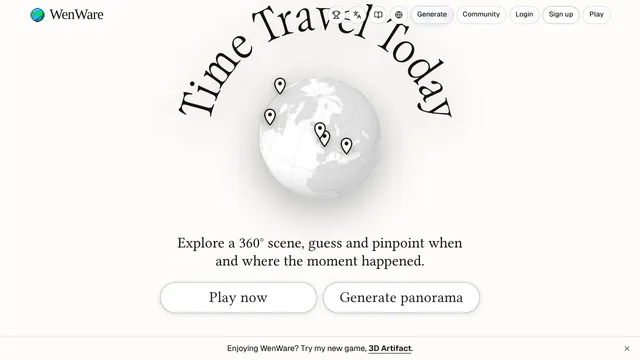
WenWare
Guess the place and year of a 360-degree historical scene.

Null Range
Fly a first-person spacecraft and dogfight other pilots online

Sunset City - The Dark Tower
Climb toward the Black Tower while sneaking past guards who watch the city.
 Claude · Action
Effective Immediately
Shoot your way out of a collapsing office nightmare as a burned-out worker.

Strilecka
Draw your own plane, then fly it in multiplayer dogfights.
Claude · Action


Questions
Are games made with AI allowed on Steam?
Yes. Steam's Content Survey asks you to disclose AI-generated content that ships with the game and, for content generated while the game runs, to describe your guardrails. Valve reviews AI-generated output the same way it reviews other content.
Does Steam allow vibe coded games?
Yes. Steam's public documentation names art, sound, narrative and localization as the content to disclose, and says efficiency gains from AI tools are not its focus. Game Developer reported in January 2026 that code helper tools used for workflow do not need disclosure; confirm the current wording in the Steamworks form.
Does itch.io allow AI-generated games?
Yes. itch.io asks projects to tag generative AI use in the AI Disclosure section, and the form lists code among the kinds. Disclosure is required and strictly enforced for asset packs, and asked for games.
How much do Steam and itch.io take from a sale?
Steam keeps 30 percent of revenue up to $10 million, and charges a $100 fee per game that it pays back once the game earns $1,000. On itch.io you choose its share, anywhere from none to all of it, with 10 percent as the default, and PayPal or Stripe take about $0.30 plus 2.9% per payment.
Can you sell games made with Claude?
Anthropic's terms give you the output rights, but which terms apply depends on your plan: the Consumer Terms cover Free, Pro and Max, and the Commercial Terms cover Team, Enterprise and API use. The Consumer Terms for residents of the EEA and Switzerland include a clause against commercial or business use, so read your version before you sell.
Can you copyright a game made with AI?
Only what a human authored, according to the U.S. Copyright Office's January 2025 report. It found that prompts alone do not give a user enough control to be the author, while human-written material, creative selection and arrangement, and creative edits can be protected.